
Master IGCSE Physics — from first principles to full marks
Clear explanations, real-world examples, and exam-ready practice take you through every Form 1–4 topic — so when exam day arrives, you're not guessing, you're ready.

I'll never give you a formula before you've felt why it has to be true.
— Renstay College
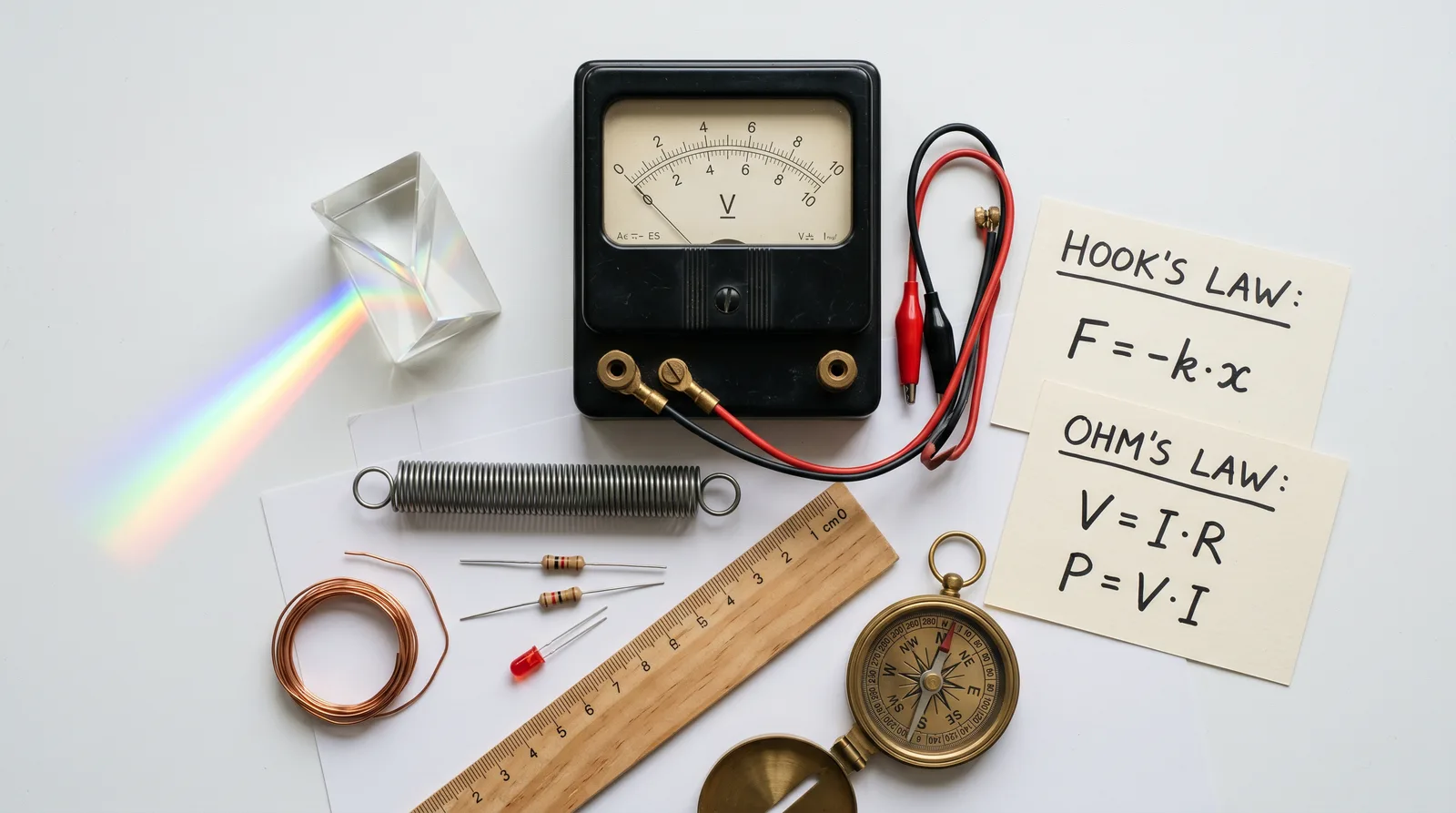
What you'll learn
What you'll be able to do
- Explain and apply core IGCSE Physics concepts across all four forms, from measurements and mechanics to waves, electricity, and atomic physics.
- Solve structured and calculation-based exam questions confidently using correct units, significant figures, and physics formulae.
- Draw and interpret diagrams — ray diagrams, circuit schematics, force diagrams, and wave representations — to the standard expected by IGCSE examiners.
- Design and evaluate simple experiments, identifying variables, sources of error, and methods of improvement in line with the practical assessment criteria.
- Translate real-world phenomena (roller coasters, household circuits, medical imaging) into physics principles, cementing conceptual understanding.
- Approach any IGCSE Physics paper with a proven exam technique: command-word recognition, mark-allocation strategy, and structured answer writing.
How it works
A school that adapts to you
This isn't a set of static videos. Every lesson is generated live and tuned to where you actually are.
We learn your level
A quick placement check tailors your starting point so you're never bored or lost.
Lessons adapt as you go
Each lesson is written for your pace and your goal, adjusting as your skills grow.
Your AI coach keeps you moving
Checkpoints, feedback, and gentle nudges turn progress into a real result.
The curriculum
What's inside your school
29 modules · 107 lessons

Measurements & the Language of Physics
Establishes the essential scientific toolkit — units, measurements, significant figures, and experimental method — that underpins every topic across all four forms.
- 1.1SI Units, Prefixes & Physical QuantitiesIncluded
- 1.2Measuring Length, Volume & TimeIncluded
- 1.3Significant Figures, Decimal Places & Standard FormIncluded
- 1.4Designing Experiments: Variables, Controls & Fair TestsIncluded
- 1.5Errors, Accuracy & Methods of ImprovementIncluded
New module
- 2.1New lessonIncluded
Motion, Forces & Energy
Covers kinematics, Newton's laws, momentum, work, energy, and pressure — the mechanical core of the IGCSE Physics syllabus.
- 3.1Speed, Velocity & AccelerationIncluded
- 3.2Distance–Time & Velocity–Time GraphsIncluded
- 3.3Newton's Laws of MotionIncluded
- 3.4Weight, Mass, Gravity & Free FallIncluded
- 3.5Friction, Air Resistance & Terminal VelocityIncluded
- 3.6Momentum, Impulse & Conservation of MomentumIncluded
- 3.7Work Done, Energy Transfers & PowerIncluded
- 3.8Gravitational Potential Energy & Kinetic EnergyIncluded
- 3.9Pressure in Solids, Liquids & GasesIncluded
- 3.10Turning Forces, Moments & EquilibriumIncluded
Thermal Physics & Properties of Matter
Explores the kinetic particle model, states of matter, heat transfer, and gas laws to explain thermal phenomena from everyday life to laboratory experiments.
- 4.1States of Matter & the Kinetic Particle ModelIncluded
- 4.2Density & Floating/SinkingIncluded
- 4.3Temperature, Thermometers & Thermal ExpansionIncluded
- 4.4Specific Heat Capacity & Specific Latent HeatIncluded
- 4.5Conduction, Convection & RadiationIncluded
- 4.6Gas Laws: Pressure, Volume & TemperatureIncluded
Waves, Light & Sound
Develops a unified understanding of wave behaviour and then applies it to the distinct properties of light and sound, including optical diagrams and medical applications.
- 5.1Wave Properties: Amplitude, Frequency, Wavelength & SpeedIncluded
- 5.2Transverse & Longitudinal WavesIncluded
- 5.3Reflection & Refraction of LightIncluded
- 5.4Total Internal Reflection & Optical FibresIncluded
- 5.5Lenses: Converging & Diverging — Ray Diagrams & UsesIncluded
- 5.6The Electromagnetic SpectrumIncluded
- 5.7Sound Waves: Properties, Echoes & UltrasoundIncluded
- 5.8Diffraction & InterferenceIncluded
Electricity & Magnetism
Builds from static charge through circuit analysis to electromagnetism and electromagnetic induction, developing both conceptual understanding and confident circuit calculation.
- 6.1Static Electricity: Charging & Electric FieldsIncluded
- 6.2Current, Voltage & Resistance — Ohm's LawIncluded
- 6.3Series & Parallel CircuitsIncluded
- 6.4Electrical Power, Energy & the Cost of ElectricityIncluded
- 6.5Household Electricity: Safety, Fuses & EarthingIncluded
- 6.6Magnetism & Magnetic FieldsIncluded
- 6.7The Motor Effect & Fleming's Left-Hand RuleIncluded
- 6.8Electromagnetic Induction & Faraday's LawIncluded
- 6.9Transformers & the National GridIncluded
Atomic Physics & Exam Mastery
Completes the syllabus with nuclear physics and radioactivity, then consolidates all four forms with targeted exam-technique training for top performance.
- 7.1The Nuclear Atom: Protons, Neutrons & ElectronsIncluded
- 7.2Radioactive Decay: Alpha, Beta & GammaIncluded
- 7.3Half-Life & Radioactive Decay CalculationsIncluded
- 7.4Uses & Hazards of RadioactivityIncluded
- 7.5Nuclear Fission & FusionIncluded
- 7.6Command Words, Mark Schemes & Structured AnswersIncluded
- 7.7Calculation Questions: Units, Formula Selection & CheckingIncluded
- 7.8Diagram & Practical Questions: Examiner ExpectationsIncluded
- 7.9Full Paper Practice & Exam-Day StrategyIncluded
Motion, forces and energy
- 8.1Physical quantities and measurement techniquesIncluded
- 8.2MotionIncluded
- 8.3Mass and weightIncluded
- 8.4DensityIncluded
Forces
- 9.1Effects of forcesIncluded
Forces continued
- 10.1Effects of forces continuedIncluded
- 10.2Turning effect of forcesIncluded
- 10.3Centre of gravityIncluded
- 10.4MomentumIncluded
Energy, work and power
- 11.1EnergyIncluded
- 11.2WorkIncluded
- 11.3Energy resourcesIncluded
- 11.4PowerIncluded
- 11.5PressureIncluded
Kinetic particle model of matter
- 12.1States of matterIncluded
- 12.2Particle modelIncluded
- 12.3Gases and the absolute scale of temperatureIncluded
Thermal properties and temperature
- 13.1Thermal expansion of solids, liquids and gasesIncluded
- 13.2Specific heat capacityIncluded
- 13.3Melting, boiling and evaporationIncluded
Transfer of thermal energy
- 14.1ConductionIncluded
- 14.2ConvectionIncluded
- 14.3RadiationIncluded
Transfer of thermal energy continued
- 15.1Radiation continuedIncluded
- 15.2Consequences of thermal energy transferIncluded
Waves
- 16.1General properties of wavesIncluded
- 16.2New lessonIncluded
Light
- 17.1Reflection of lightIncluded
- 17.2Thin lensesIncluded
- 17.3Dispersion of lightIncluded
- 17.4Electromagnetic spectrumIncluded
- 17.5SoundIncluded
Electricity and magnetism
- 18.1Simple phenomena of magnetismIncluded
Electrical quantities
- 19.1Electric chargeIncluded
- 19.2Electric currentIncluded
Electrical quantities continued
- 20.1Electromotive force and potential differenceIncluded
- 20.2ResistanceIncluded
- 20.3Electrical energy and electrical powerIncluded
Electric circuits
- 21.1Circuit diagrams and circuit componentsIncluded
- 21.2Series and parallel circuitsIncluded
Electric circuits continued
- 22.1Action and use of circuit componentsIncluded
- 22.2Electrical safetyIncluded
Electromagnetic effects
- 23.1Electromagnetic inductionIncluded
- 23.2The a.c. generatorIncluded
- 23.3Magnetic effect of a currentIncluded
Electromagnetic effects continued
- 24.1Force on a current-carrying conductorIncluded
- 24.2The transformerIncluded
The nuclear model of the atom
- 25.1The atomIncluded
- 25.2The nucleusIncluded
Radioactivity
- 26.1Detection of radioactivityIncluded
- 26.2The three types of nuclear emissionIncluded
Radioactivity continued
- 27.1Radioactive decayIncluded
- 27.2Half-lifeIncluded
- 27.3Safety precautionsIncluded
The Earth and the Solar System
- 28.1The EarthIncluded
- 28.2The Solar SystemIncluded
Stars and the Universe
- 29.1The Sun as a starIncluded
- 29.2StarsIncluded
- 29.3The UniverseIncluded
Who it's for
Is this you?

The Form 1 Starter
Just beginning IGCSE Physics and wants a structured, friendly foundation before school lessons move too fast.

The Form 4 Exam Sprinter
Racing toward the final paper and needs sharp exam technique and full-syllabus revision in one place.

The Struggling Mid-Former
Finds certain topics — electricity, waves, graphs — genuinely confusing and needs clear explanations that actually stick.

The Supportive Parent
Wants to understand what their child is studying so they can ask the right questions and help with homework confidently.

The High-Achiever Pushing for Top Marks
Already doing well but wants the deeper conceptual understanding and examiner insight to move from good to outstanding.

The Supplementary-Resource Teacher
A secondary school teacher looking for well-sequenced, syllabus-aligned materials to complement classroom instruction.
Questions
Frequently asked
Your teacher
A note from your teacher

Renstay College
If you've ever stared at a Physics question, known you understood the topic, and still walked away unsure whether your answer was right — I built this school for you.
I know what it feels like to find Physics simultaneously fascinating and frustrating. The concepts are genuinely brilliant — momentum, electromagnetic induction, radioactive half-life — but the gap between "I sort of get it" and "I can actually answer this exam question correctly" can feel enormous. That gap is exactly what this school is designed to close.
Here's my philosophy: understanding has to come before memorisation, every time. So we never start with a formula. We start with a question you already know the answer to — why does a skydiver stop accelerating? What actually happens inside a wire when you switch on a light? Why does a spoon feel colder than a wooden table even when they're both in the same room? Once the concept clicks in a context that makes sense, the physics — and the maths — slots in naturally. That's not a teaching trick; it's just the right order to do things.
We cover every corner of the IGCSE Physics syllabus, from getting your significant figures right on Day 1 all the way to nuclear fission and full-paper exam strategy before your final sitting. And throughout all of it, we treat exam technique as a skill in its own right — because knowing your physics is necessary, but it isn't sufficient. You also need to know what explain means versus describe, how to lay out a calculation so an examiner follows your working, and how to draw a ray diagram that actually earns its marks.
This school is for students in Forms 1 through 4, for parents who want to understand what their child is learning well enough to help at home, and for teachers looking for a clear, well-structured supplementary resource. Wherever you're starting from, there's a place for you here. I'm glad you found us — let's get to work.
— Renstay College
Start your journey today
Get instant access — learn at your own pace with an AI coach in your corner.
$10/mo
Recurring billing · cancel anytime
Enrolling a child? Sign up as a parent — you'll add your student right here after.
Secure checkout · Instant access
- 29 modules, 107 lessons
- AI-adaptive lessons tuned to your level
- Quizzes & checkpoints to lock in progress
- Your own AI learning coach
- Learn on any device, at your pace
- Full access for as long as you're subscribed